Social Media Outreach in 2022

From a product or services firm perspective: Pick two or three social media platforms and concentrate on mastering those (if resources allow). If resources are limited, concentrate on Facebook and Twitter first. Determine which serves your brand or service better. Whether you are a seasoned social media marketer, a marketer looking to venture into social media marketing, or a business owner looking to leverage on social media, it’s helpful to know the most popular social media sites around that will amplify your brand. Choose the most popular platform based on your company’s product or client demographics. For example, Financial Advisors would choose Facebook, LinkedIn or Twitter over Instagram. Actual product marketers that need more “visual” branding would gravitate towards Instagram or Pinterest.

First things first. Establish Trust. People naturally look to other people as a guide for their own behavior. Don’t get spammy with your posts or tweets. Post social media content that is quality and  compelling (always include an image). Encourage free exchange. Be open to change and continuous learning. Social proof (trust) typically rises exponentially, and it will become a self-perpetuating force.

Remember to establish reasonable goals once you start gaining momentum. Listen to your customers or fans (followers). Always gain feedback and adjust accordingly (iterate). Figure out what to measure when putting together goals. Example: do you measure “followers” or “likes” “retweets” or “retention” or “sales”?

Your goals should be distinct, in that you have a specific, defensible reason for participating in each platform. Take a look at your outreach strategy and review the reasons your business is implementing a social media marketing outreach plan. What do you want out of your social activities? Are you trying to drive visitors to your website, your blog, via Twitter or your Facebook page? Are your competitors on social media? Focusing on your ultimate goal will guide your next steps: what you do (what other channels you will use going forward), when you do it (what schedule you will aim for? Night or Daytime according to your demographic), and what content to share. Be vigilant and always participate every day (even if you have to schedule and automate it). Social Media marketing is a slow process that will pay off dividends in the future!
Pinterest Business Tips for Success in 2022

  1. Publish high resolution photos of your product. The ideal image dimension is 736 pixels wide. Pinterest will display your image at it’s maximum size up to 736 pixels wide. As long as its 736 pixels wide, Pinterest will adjust the dimensions. Also, highlight customers using your product. Ask them to submit pictures. Acknowledge them and give them a discount coupon for this content.
  2. Make sure your website is set up to be shared socially on Pinterest. Make the social sharing buttons on your content pages easy to find and use.
  3. Repinning. Repinning isn’t like “retweeting” on Twitter. You’ll want to be sure to update the caption on a repinned pin to make it your own.
  4. Make sure you “verify” your website by Pinterest! Show pinners you’re a trustworthy source. Directions and steps here.
  5. Connect your Instagram, YouTube, and/or Etsy accounts. Doing so ensures pins from these sites will be attributed to your business. Plus, you’ll also be able to track related analytics.
  6. Optimize for Pinterest SEO. Just like any search engine, keywords are the basis for content discovery on Pinterest.
  7. Target the right Pinners with ads. Drill down and target your product audience.
  8. Develop a powerful content. High-resolution images, infographics, creative sticky content.

Pinterest the perfect place to showcase your brand, business and products to an engaged marketplace with plenty of spending power. Think of creative ways to feature your products and services in tutorials or other content, and it will work much better than simply pinning your latest advertisement.


Pinterest Marketing for Small Business in 2022

Pinterest has seen a huge growth of users in 2020-2021. Pinterest can help certain small business increase their referral traffic from visually rich content which gets published on the site. With the launch of Pinterest for Business Pages, small business brands must take advantage of the platform. Pinterest for Business Pages is essentially its version of Facebook Pages for business. It’s important to note there are personal and business accounts on Pinterest.

The Pinterest business account gives you access to Pinterest’s Built-In Analytics Dashboard as well as the ability to advertise: Promoted Pins, Buyable Pins. Your Pins are optimized for business: Rich Pins and Pin Statistics for each Pin and a business account will get access to new features before a personal account. A Pinterest personal account is ideal if you want to find things. With a personal account, you can still upload your own pins, but you won’t be able to see the statistics on the things you pin.

The good news is that Pinterest is offering the option to either create a new business profile, or convert your existing personal one. This is done through the Pinterest Business Center, where you simply create a new account or click to convert your existing one.

Pinning strategies include “Repinning”, which is a great way of building up new followers, but to be truly influential, you need to pin your own content regularly and before everyone else. Pinterest is a very visual site, but there’s nothing to say that you can’t pin videos on your boards. It’s good to mix up your content a little and provide these links, just to see how exactly your followers react to it.

While your descriptions can go up to 500 characters, the chances of people reading the entire description (unless it’s a competition) is slim. This is especially true when you consider that only a small portion of that description will be visible when you’re browsing boards. It’s best to keep descriptions short and sweet so that both the image and text is easily visible.

Why is Pinterest getting so popular amongst small business brands and Marketing SEO?

According to data released by SimilarWeb also found that Pinterest receives 58.78% of direct desktop traffic and 37.98% from the organic search. They also got 1.4% traffic from referring sites like Amazon and Etsy. Most consumers using Pinterest head straight to the site when looking for inspiration or products to buy, with few visitors from Social, Mail, or Display Advertising.

Finally, and very important! Make sure to verify your website with Pinterest which enables you to become visible in search results (SERPs). To do this, simply add a HTML tag from Pinterest to the header of your website. You have to add an HTML tag to your website’s source code so Pinterest can confirm that you own the website you want to claim. By claiming your website, you get access to analytics for the Pins you publish from your site, the analytics on Pins that other people create from your site and let people know where they can find more of your content. Simple.

Website Optimization – Heatmaps in 2022

The use of “heatmaps” is a great tool when optimizing your website for maximum success. Heatmaps are just one of the many tools (Google Analytics, A/B testing, conversion funnel) in your arsenal to help identify and fix certain sections of your company’s website. Heatmaps are a way to visualize different types of data, including where people’s eyeballs first land on your site and how likely your visitors are to click on different areas of your pages.This type of information can be especially useful in showing you where to place your most important links, as well as which elements on your site should be linked. A heatmap is a snapshot look at where your website visitors are focusing their attention.

Another good tool is the “mouse” movement heat map. This type of information can be especially useful in showing you where to place your most important links, as well as which elements on your site should be linked. This type of heatmap can be extremely useful to internet marketers, as they help to determine the ideal placement for any promotional information. Most heat map tools are not free. However, the free tools are really low quality. Go with the paid tools.

Tip: I like Crazy Egg heatmap reports. Its a reasonable, paid tool with quality heat mapping options. The use of heatmaps is crucial in making content creation and website design decisions!

A heatmap is one of the most powerful and efficient diagnostic tools with which you can uncover a large amount of insights on how visitors interact (travel) with your web pages and use those insights to improve your website’s engagement funnel journey.

The Importance of Basic Content Marketing in 2022

Besides driving traffic to your company’s website, good sticky content reinforces your brand – The brand becomes a more noticeable name online as people share your content and start commenting on it, retweeting it, and helping it to build trust. These effects “gel” over time and you will see the website traffic increase, SEO benefits (rank higher on Google) and hopefully a conversion (website funnel strategy) in the end. Strong pieces of content can help you become more visible online, both on search engines and in social media. Your social media platforms are one of the best ways to connect and share content with your target audience.

Content creation success is measured many ways including:

– Spike in visitor traffic and page views on a specific content post.
– The number of Shares, Likes, Pins, ReTweets on Social Media.
– Media mentions and stories covering your business or firm.
– Website ranking (SERPs) increase.
– Conversions. Actual product sales or new clients (example: Financial Services).

If you lack the resources for generating content, outsource to an agency or freelancer for help. The basic purpose is to create content and try to post at least 2-3 times per week. Content is scalable and you can add as needed or when more resources become available. Content Marketing is important! Without it, you’re going to struggle to attract the attention you need to collect leads and convert them into sales or clients!

Basic Content Creation Strategy for Financial Advisors in 2022 (updated)

Keep it simple but make sure its thorough! Content Strategy Answers the Question ‘Why’ You’re Publishing Content.

  1. Understand your firm and how it works. Clients and brand considerations. What do you specialize in? Retirement? Wealth Management? Trusts? Client demographics. The specialization (client persona demographics) will dictate the kind of content you should plan to generate.
  2. Collect data. Competitive analysis, Keywords, Customer (client) research.
  3. Audit your website. Google Analytics. Traffic data. Conversion and bounce rates, etc. SEO metrics.
  4. Prospect company’s key influencers and where your customers or potential live online. Do they live on Twitter? Facebook? Do you think they would gravitate to you via another platform such as YouTube if you made instructional financial videos? or maybe subscribing to a Podcast?
  5. Create useful, exceptional content (blog posts, landing pages, contact forms, eBooks, videos, infographics, case studies) according to steps 1-4. Rank them in importance and create content accordingly. Ensure that editorial standards are being followed. Make sure the content is compliant if you are a Financial Advisor. Pictures and videos should be high-resolution.
  6. Measure content performance. Google & Social Media Analytics. A/B testing, etc.

If you lack the resources for generating content, outsource to an agency or freelancer for help. Content strategy is the foundation on which successful content marketing is built. Content marketing is the journey towards success, content strategy is the blueprint that directs it.

Protecting Your Online IP (Intellectual Property)

Intellectual property (IP) are legal property rights over creations of the mind, both artistic, commercial, and the corresponding fields of law. Common types of intellectual property include copyrights, trademarks, patents, industrial design rights and trade secrets. (WikiPedia)

If you have an innovative, brilliant Marketing campaign(s) or Strategy and you want to tell the world about them (Twitter, Facebook, blogs, conferences) you may want to think again. It’s called “competitive advantage” and you want to keep it “close to the cuff” as much as possible. Why? So your competitors won’t jump on your coattails and follow the same tactic. Why would you want to give out your marketing strategies? Ego perhaps, or to generate traffic to your blogs, corporate website or increase your Twitter following? Forget it. Again, think about your competitors and think about your sales or services business.

*This blog entry is for most companies or service oriented businesses and not necessarily for Marketing + Social Media blogs (like mine) that give out basic digital marketing strategy.

Below are some important tips for making sure your ideas are preserved. I have only listed a few but there are many more safeguards that can be set up in the “process”:

  1. Create a policy. Establish a policy for all of your intellectual property – including all patents, logos, designs, trademarks, copyrights and domain names. Policy comes first. Give yourself a competitive advantage. Just because you think there’s no competition out there for your business, don’t use that as an argument not to spend the money to protect your idea.
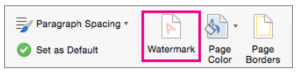
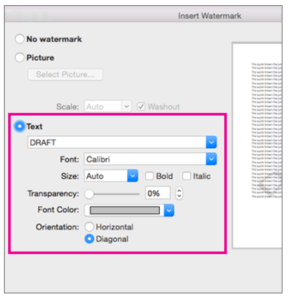
  2. Keep all marketing strategy and reports under a “red cover” confidential. If the IP is printed on hard copy, always have a red cover sheet up front to remind everyone that this information is confidential. If you’re marketing strategy (or IP) is distributed by email or document files, make sure everyone one on your team knows and writes (sig file) “confidential”. Clearly label sensitive data as “confidential” (or put a “watermark” right on the document), and explicitly state this fact in your email. Perhaps go as far as hold a team/staff meeting and explain the fact that if ANY confidential strategy IP gets outside of the company, that person will be fired. Example of setting up a confidential watermark in MS-Word below.

  1. Copyright. Have you written an article, eBook, created a video or made a podcast? You’ll want copyright protection. Once you have created the work, you have the exclusive right to reproduce, adapt, distribute, perform and display it.
  2. Trademark/Service mark. Got a logo or tagline you want to use? Look into trademark protection. Service marks provide the same protection for intangible things such as services.
  3. Non-disclosure Agreement (NDA). A common approach is to make sure that anyone you share the IP information………..signs a “non-disclosure agreement” (NDA) prior to your disclosure. Typical NDAs contractually obligate signatories to refrain from disclosing confidential information without the disclosing party’s express consent.
  4. If you have client newsletters or email blasts, do not go into details of your marketing strategy. Leave that for your face-to-face meetings.

Company marketing strategy should be guarded. Share your strategy on a need-to-know basis, and make sure everyone with access understands the importance of keeping this information confidential.

What is your Brand’s Story? Are You Prepared to Capitalize on it?

The best way to get into the press is by having an amazing brand story. Once you figure out your Brand’s story, its time to dial-in the digital marketing aspect. Time to get some media attention. Start building relationships (example: Twitter) with Journalists before you need them. Distribute Press Releases. Create a website Resource Center for media. Write guest articles. Make Podcast appearances.

Now its time to capitalize on it! The next biggest thing you need to figure out is where your readers & visitors are going to go after hearing about your company (brand) product or services. The target should be company website or specific landing page. The focus should be on a conversion strategy and website funnel design. Ideally, this should be figured out and created BEFORE seeking media coverage. Once everything is in place and the website conversions play out out, its manifest destiny.


Digital PR Tips for 2021

A short, brief list of digital PR tips & essentials. The target of Digital PR is to get high-quality backlinks from online publications and websites. You need to target the websites, podcasts, and social media accounts being browsed & loved by your target audience.

  1. PR blog posts and press releases views happen mostly on Mondays and Wednesdays. First thing in morning.
  2. Tuesdays are a bad day to issue a PR or a good story on your company’s blog…people tend to work and stay focus on Tuesdays.
  3. Fridays are bad. Fridays see very little traffic to content. Everyone is out to lunch on Fridays or gets in late to work.
  4. If you do send out a press release (wire), post it on your company blog as well = more traction.
  5. Ideal blog post length is between 1,000-2,000 words.
  6. Make your PR or story post link-worthy. Do not forget a great image (hi-res) or visual to your digital content like an Infographic. Add keyword themes associated with the brand, product or service.
  7. All Press Releases and PR campaign’s must contain complementary digital assets in order to get links. Links are symptomatic of good PR. Your SEO team should be helping your PR team optimize the links in all of their earned media coverage. SEO can help with PR keyword links that will rank high on a Google Search Engine Results Page (SERP).
  8. Twitter is a perfect PR distribution platform. Use Twitter for media relations. Busy reporters & reviewers do not answer their phones and receive countless e-mails, but they do pay attention to Twitter! Twitter is a great way to link a press release or a quality company blog post. It adds traction and traffic (value-add). Twitter can also be used to Pitch. Before any pitch has been made on Twitter to @journalist follow them for a few months. Get to know them. If you like what they are doing and reporting, retweet them or give them props! Share their stuff and links to their articles. If @journalist needs info or asks for help, reach out immediately and make it your priority. Help them out, and they will help you out. It goes both ways. Let the reporter know you’ve been driving traffic to their story. Keep the pitch respectful and short. Example: @journalist Do you accept story pitches? @journalist I just sent you an email, take a look when you get a chance. Its a good fit for your outlet.
  9. Facebook. Yes, @journalist use Facebook as well. @journalist will use Facebook on their own or through their publication page. Share their stories + interact with their readers. Interact with them and become visible by liking and commenting on their posts. Establish a professional relationship.
  10. Build a journalist / reporter list for your niche. Need to build a good list of Press for your particular product or service? Start with research. A good shortcut is to use JustReachOut. JustReachOut is a website dedicated to finding reporters who have written about your particular product or service. Just add your company’s product category in the search box, and the engine will bring up reporters interested and have written about your industry. Connect with them and reach out.

Lastly, monitor your news and social coverage by analyzing website referral traffic (Google Analytics). Figure out what works, and what doesn’t. Social proof for brands is now about data and metrics. Digital PR has become an inseparable part of the digital marketing strategy. Takeaways from this quick tips bog post will help improve your next Press Release (PR) strategy!