SWOT Analysis for Your Social Media Business Accounts with Key Metrics

In the dynamic world of digital marketing, social media platforms serve as essential channels for businesses to engage with their audience. For a marketing director, periodically assessing your social media business accounts is vital. A SWOT analysis, augmented with key metrics, provides a holistic perspective, enabling a more data-driven social media strategy.

Strengths:

  1. Direct Engagement: Social platforms empower businesses to converse with their audience instantly.
    • Metric: Engagement Rate (likes, shares, comments per post)
  2. Cost-Effective Branding: Crafting an impactful brand identity can be achieved economically.
    • Metric: Cost Per Impression (CPI) or Cost Per Engagement (CPE)
  3. Diverse Demographic Reach: Platforms cater to various demographics, broadening potential outreach.
    • Metric: Audience Demographic Distribution (age, gender, location)

Weaknesses:

  1. Time Intensive: Consistently producing quality content and interaction requires significant time.
    • Metric: Time Spent per Post vs. Engagement
  2. Reputation Risk: A single negative comment or review can have a ripple effect.
    • Metric: Negative Sentiment Percentage in Comments/Reviews
  3. Dependence on Platform Algorithms: Organic visibility can be curtailed by algorithm changes.
    • Metric: Organic Reach Rate

Opportunities:

  1. Leveraging Influencers: Partnering with industry-relevant influencers can amplify your brand’s voice.
    • Metric: Engagement and Conversion Rates on Influencer-driven Posts
  2. E-commerce Integrations: Merging content and commerce is now more seamless, especially on platforms like Instagram.
    • Metric: Click-through Rate (CTR) for Shoppable Posts
  3. Emerging Platforms: Early adoption of new platforms can offer unique advantages.
    • Metric: Growth Rate and Engagement on New Platforms

Threats:

  1. Platform Saturation: Standing out amidst the cacophony is challenging.
    • Metric: Share of Voice (percentage of total conversations about your brand vs. competitors)
  2. Shifts in User Preferences: Platform migration can affect your core audience.
    • Metric: Monthly Active Users and Churn Rate
  3. Ad-Blocker Proliferation: Reaching audiences through ads is increasingly complex.
    • Metric: Ad Visibility Rate and Effectiveness

Wrapping Up

Integrating metrics into your SWOT analysis ensures a more grounded and actionable assessment of your social media endeavors. By incorprating qualitative insights with quantitative data, you’ll be better positioned to optimize engagement, navigate challenges, and realize your business goals.

Blow Up Your Social Media Strategy – Team Up With Engineering and Sales Today

If you’re running a business in today’s digital age, you’re no stranger to the importance of a robust social media strategy. It’s not just about crafting compelling tweets or creative Instagram stories; it’s about understanding your audience, leveraging your products and services, and ultimately driving growth. But are you unlocking the full potential of your strategy? The secret to explosive success might just lie in two unlikely allies: your engineering and sales teams. Let’s explore how this cross-functional collaboration can supercharge your social media efforts.

Breaking the Marketing Silo

Traditionally, marketing teams have operated in their own silo, isolated from the rest of the organization. This approach often leaves marketers with an incomplete picture of what they’re marketing. By integrating with engineering and sales, marketers can better understand the product and customer perspective, leading to more informed and effective strategies.

A Better Grasp of the Product

Consider the potential power of your engineering team’s knowledge and insight. These are the people who design and build your products or services. Their technical understanding can add depth to your marketing content that’s hard to replicate. They can highlight features that may not be immediately obvious but can differentiate you from the competition.

Real-world example: Microsoft has leveraged this tactic effectively, often featuring their engineers in their social media content. They discuss the technical aspects of their products, explaining their capabilities, benefits, and how they stand out in the market. This strategy gives their audience a deeper understanding of their products, leading to increased engagement and conversions.

Understanding Your Customer

Your sales team is on the frontline, interacting with customers and potential customers daily. They have an in-depth understanding of customer needs, preferences, pain points, and what they value about your product. Incorporating this knowledge into your social media strategy can enhance your content’s relevance and resonance.

Real-world example: The CRM platform, Salesforce, has been known to leverage the insights from their sales team in their marketing strategy. They use real-life customer queries and pain points to create relevant, engaging social media content that answers potential customers’ queries before they ask them. The result? Improved customer satisfaction and increased lead generation.

Data-Driven Insights

Perhaps the most significant advantage of teaming up with engineering and sales is the potential for data-driven decision-making. Both teams generate a wealth of data that can significantly enhance your social media strategy when correctly analyzed and applied. You can gain insights into which product features attract the most attention or which customer needs drive the most sales and tailor your content accordingly.

Metrics that matter: After implementing a cross-functional approach, the clothing retailer ASOS reported a 30% increase in their social media engagement rate and a 25% increase in conversions from social media traffic. This improved performance was attributed to a more nuanced understanding of their products and customers, achieved through closer collaboration with their engineering and sales teams.

Final Thoughts

Blasting off your social media strategy may be as simple as knocking down internal walls and embracing a collaborative, cross-functional approach. With a deeper understanding of your products and customers, you can create content that attracts, resonates, and drives growth.

According to a study by the Aberdeen Group, organizations with aligned sales and marketing teams achieved an average of 32% annual revenue growth, while less aligned companies reported an average of 7% decline. This significant gap proves that interdepartmental collaboration is beneficial and essential for a thriving business.

In another example, the marketing software company Adobe Marketo is an excellent service that uses rich behavioral data, built-in intelligence, and sophisticated journey flows to identify and engage your best customers and accelerate the customer experience. Reported a 67% higher conversion rate when sales and marketing teams were in sync, emphasizing the power of a unified approach.

Start bridging the gap today and watch your social media strategy soar. With the combined insights and strengths of your engineering and sales teams, there’s no telling how high your business can climb.

How to Take Your Small Business to the Next Level with a Social Media Marketing Plan that Utilizes Community Collaboration, Demographics, and Industry Insights

In today’s digital age, social media has become an essential tool for small businesses to connect with their target audience and drive sales. However, creating a successful social media marketing plan can be daunting, especially for those who are new to the world of social media marketing. The key to standing out from the competition and achieving success on social media is to craft a marketing plan that leverages the power of community collaboration, demographics, and industry insights.

In this blog post, we’ll explore how your small business can take advantage of these three essential elements to create a social media marketing plan template that will help you take your business to the next level. Whether you’re just starting out or looking to revamp your existing social media strategy, this post is for you!

Developing a successful social media marketing plan is crucial for small businesses that aim to compete in today’s digital marketplace. To create an effective plan, it’s essential to focus on community collaboration, demographics, and industry insights.

Community collaboration involves engaging with your target audience and creating a sense of community around your brand. One way to do this is by using user-generated content (UGC), which encourages customers to share their experiences with your brand on social media. This type of content is valuable because it’s authentic and relatable, and helps build trust between your brand and your audience.

Another way to foster community collaboration is to leverage social media influencers. These individuals have a significant following on social media and can help promote your brand to their audience. By working with influencers, you can reach a wider audience and gain credibility with your target market.

Demographics play a crucial role in social media marketing, as they help you identify your target audience and tailor your content to their interests and preferences. It’s important to understand the demographics of your target audience, such as age, gender, location, and interests, so that you can create content that resonates with them.

Industry insights refer to the trends, best practices, and strategies that are prevalent in your industry. Keeping up with industry insights can help you stay ahead of the competition and create content that is relevant and valuable to your audience. One way to stay up-to-date on industry insights is to follow industry thought leaders on social media and attend industry events.

Now that we’ve explored the three essential elements of a successful social media marketing plan, let’s take a look at how you can create a template that incorporates these elements. Here’s a template that I use with my clients:

  1. Define your target audience: Identify the demographics of your target audience, such as age, gender, location, and interests.

  2. Set your goals: Determine what you want to achieve with your social media marketing plan, such as increasing brand awareness, driving sales, or building a community around your brand.

  3. Choose your platforms: Select the social media platforms that are most relevant to your target audience and align with your goals.

  4. Develop your content strategy: Create a content strategy that incorporates UGC, social media influencers, and industry insights to engage with your audience and build a sense of community around your brand.

  5. Establish metrics for success: Define the metrics that you will use to measure the success of your social media marketing plan, such as engagement rate, reach, and conversion rate.

By using this template as a starting point, you can tailor your social media marketing plan to suit your business’s unique needs and goals. Remember to focus on community collaboration, demographics, and industry insights to create a plan that helps you take your small business to the next level.

How Sticky Inbound Marketing Blog Post Content Can Boost Social Media Metrics

Do you ever wonder why some companies can craft content that drives a huge surge in visitor traffic on social media? Applying sticky inbound marketing principles can help your business ascend beyond average levels of interaction and jumpstart sustained engagement with potential customers. By combining creative strategies with powerful insights, businesses can capture users’ attention and increase relevant metrics like likes, shares, retweets, comments and so much more! In this blog post we will look into how utilizing the power of sticky inbound marketing blog content can provide your company a major boost to its social media presence.

What is Sticky Inbound Marketing Blog Content and How Does it Generate Social Media Traffic

Sticky inbound marketing blog content refers to the creation of highly engaging, informative, and share-worthy articles that entice readers to spend a considerable amount of time on a website and share them with their social networks. In this digital age, competition for consumer attention is fiercer than ever, and that’s why businesses must focus on designing blog content that “sticks” to the audience like glue. This way, not only will readers be more likely to return, but they’ll also amplify the content’s reach by sharing it with their followers on various social media platforms such as Facebook, Twitter, LinkedIn, and Instagram. By targeting the audience’s pain points, connecting with their emotions, and consistently delivering value through well-researched and insightful articles, sticky inbound marketing blog content becomes a powerful tool for driving social media traffic, increasing brand exposure, and ultimately, converting visitors into loyal customers.

Creating Engaging sticky quality Content for On-Page SEO Optimization

Crafting engaging, sticky-quality content is the cornerstone of any successful on-page SEO optimization strategy. It is through this content that users are captivated, maintaining their attention and encouraging them to explore the rest of your website. But striking that perfect balance of information, presentation, and entertainment can be challenging. To create content that truly resonates with your target audience, you must venture beyond mere keyword insertion and dive deep into the realms of technical SEO, user intent, and multimedia integration. This kind of attention to detail not only embellishes your website’s organic visibility but also fosters credibility among prospective visitors. Strive for that harmonious blend of data-driven precision and creative expression in your content and watch as your on-page SEO optimization yields tangible results, catapulting your website to new heights of desirability and influence.

Ways to Leverage Social Networks to Increase Website Visitor Traffic

In today’s digital era, it is essential to harness the power of social networks to maximize website visitor traffic. Utilizing these online platforms effectively can lead to significant growth in online visibility, brand awareness, and ultimately increased website traffic. To achieve this, it is vital to create shareable, engaging content as well as strategically planned posts that resonate with your target audience. Moreover, participating in niche communities allows for meaningful interaction with potential visitors, while collabоrating with influencers can expand your reach and enhance your credibility. Additionally, keep track of insightful data and analytics to optimize your social media strategies and continually refine your approach. By leveraging social networks and employing these techniques, you can tap into the vast potential of these platforms and exponentially boost your website traffic.

Tips for Crafting Shareable sticky Headlines and Copywriting

In today’s fast-paced digital landscape, crafting shareable, sticky headlines and employing an effective copywriting tone of voice have become vital elements in any successful content strategy. To create a headline that captures the audience’s attention and triggers an urge to click, consider using unique and compelling language that steers clear of clichés and overused phrases. Be concise yet intriguing, with a touch of curiosity to leave readers longing for more information. Additionally, the copywriting tone of voice plays a crucial role in enabling the content to resonate with readers on an emotional level, shaping their overall perception of it. Adopt a tone that reflects your brand’s personality and caters to your target audience’s preferences, while maintaining authenticity and consistency throughout your content. By prioritizing these aspects of headline creation and copywriting, content creators can confidently enhance their content’s shareability and engagement potential in today’s competitive online environment.

Realistic Ways to technically Measure the Impact of Your Content such as likes, website traffic, shares, retweets

In today’s digital landscape, accurately gauging the impact of your content is vital for optimizing its reach and effectiveness. Various technical indicators facilitate the measurement of your content’s performance. For instance, social media platforms offer valuable metrics like “likes,” “shares,” and “retweets” to evaluate audience engagement and how widely your message is being disseminated. Moreover, analyzing website traffic helps you understand the number of users visiting your site and the specific pages receiving the most attention, allowing you to adjust your content strategy accordingly. By leveraging these quantitative metrics alongside other qualitative feedback from your target audience, you can efficiently identify the strengths and weaknesses of your content and continuously improve its overall impact.

Strategies for Consistently Growing and creating high-quality content on your website to share with Your Audience on Social Media Platforms

In today’s digital age, consistently growing and creating high-quality content for your website is crucial to maintain a strong presence on social media platforms, and effectively engaging with your target audience. Among various strategies, consistency is key – ensure that you regularly update your website with fresh and innovative content. Focusing on packaging information in visually appealing, easily digestible formats – such as infographics or short videos – can significantly boost your content’s shareability. Moreover, engaging with trending topics and incorporating them into your content can help you tap into a larger audience, while still maintaining relevance to your niche. Additionally, adopting a data-driven approach by closely monitoring your audience’s interactions with your content and analyzing their preferences will allow you to tailor your content strategy, ensuring that you deliver content that resonates with your audience. Ultimately, meticulously planning your content calendar, while being responsive to audience feedback and analytics, is fundamental to growing your website and solidifying your brand on social media platforms.

Crafting proactive and engaging inbound marketing content with SEO optimization, shareable headlines, and copywriting, plus utilizing the right social networks are all ways that can help you increase your website’s overall traffic engagement. Sharpening up your social media analytics is also a great way to measure the impact of your sticky content and track organic search engine optimization. But this art mustn’t remain stagnant, it needs to be consistently updated with quality content both on-page and off-page for sustainable growth, as well as for keeping in touch with your audience across numerous social media platforms. So if you’re ready to captivate new customers and increase popular metrics such as likes, website traffic, shares, and retweets from potential target audiences – get cracking! Ready to boost your social media metrics and drive more traffic to your website? Find out how sticky inbound marketing blog posts can help you achieve those goals today!


Content Creation Success Metrics for a Better Plan

Content creation success metrics are indicators that measure how well your content performs in terms of achieving your goals. There are different types of metrics depending on what you want to achieve with your content, such as exposure, engagement, conversion, or redistribution.

Content Strategy Answers the Question ‘Why’ You’re Publishing Content. Establishing content creation success metrics (KPIs) can determine how your marketing is performing as well as RIO. Below is a list of good basic success metrics for your content creation strategy:

    • Spike in visitor traffic and page views on a specific content post.
    • The number of Shares, Likes, Pins, and ReTweets on Social Media.
    • Media mentions and stories covering your business or firm.
    • Website ranking (SERPs) increase.
    • Conversions. Actual product sales or new clients (example: Financial Services).

Some alternative content creation success metrics that you can watch out for are:

    • Leads: This metric tracks how many potential customers you generate with your content. For example, if you offer a gated resource that requires registration, you can measure how many new leads that resource brings in.
    • Sales: This metric tracks how many actual customers you acquire with your content. For example, if you have a product page that showcases your features and benefits, you can measure how many visitors click on the buy button or complete a purchase.
    • Retention: This metric tracks how many existing customers you retain with your content. For example, if you have a blog that provides valuable information and tips for your users, you can measure how many return visits or subscriptions you get.
    • Advocacy: This metric tracks how many loyal customers you create with your content. For example, if you have a testimonial page that showcases positive feedback and reviews from your users, you can measure how many referrals or ratings you get.

If you lack the resources for generating content, outsource to an agency or freelancer for help. The basic purpose is to create content and try to post at least 2-3 times per week. Content is scalable and you can add as needed or when more resources become available. Content Marketing is important! Without it, you’re going to struggle to attract the attention you need to collect leads and convert them into sales or clients!

How to Perform a Year-End Social Media Business Audit

A year-end social media business audit can help you identify areas for growth and set goals for the coming year. A social media audit is a process used to measure the success of your social strategy across accounts and networks. An audit identifies your strengths, weaknesses, and the next steps needed to improve. Here’s how to get started:

  1. Review your social media metrics: Look at your social media analytics to see how your pages have performed over the past year. Look at metrics such as engagement, reach, and followers. Make note of any spikes or dips in these metrics and try to identify what may have caused them. For each platform, record your username or handle the URL, and the number of followers or subscribers, engagement metrics, or any other KPIs that might be relevant to each channel.
  2. Assess your content: Take a look at the types of content you’ve been posting and how well they’ve been received by your audience. Think about what has resonated with your followers and what hasn’t. You may also want to consider what types of content you want to focus on in the coming year.
  3. Evaluate your social media strategy: Consider whether your current social media strategy is still aligning with your business goals. Are you using the right platforms for your target audience? Are you posting at the optimal times? It may be time to reevaluate your strategy and make adjustments as needed.
  4. Audit your social media presence: Take a look at how your business appears on each social media platform. Are your bios and profile pictures up to date? Do your posts accurately reflect your brand voice and aesthetic? Make sure everything is cohesive across all platforms. Tools such as Agorapulse can analyze your content on Twitter & Instagram. Hashtagify is a cool tool that will allow you to identify related hashtags to the one that has worked best for you. The tool is freemium and it will show you related and popular hashtags for free. Buzzsumo has a handy Facebook audit feature allowing you to analyze the content of any page, and even compare it to competitors’ pages.
  5. Identify areas for improvement: Based on your review of your social media metrics, content, and strategy, identify areas where you can improve. Maybe you must focus on creating more visually appealing content or engaging more with your followers. Make a list of actionable steps you can take to improve your social media presence in the coming year. See what popular posts within each platform and across platforms have in common. The type of post, the target audience of the post, the time it was posted, and any media in the post are things to explore.
  6. Set goals: Once you’ve identified areas for improvement, set specific, measurable, achievable, relevant, and time-bound (SMART) goals for the coming year. This will help you stay focused and progress toward your social media objectives. Your social media goals should be about how social media can benefit your business, including increasing brand awareness, engagement, and traffic to your website.

A year-end social media business audit is a crucial step in helping your business grow and thrive on social media. By reviewing your metrics, assessing your content and strategy, and identifying areas for improvement, you can set yourself up for success in the coming year.

How to Measure Leads Through Social Media

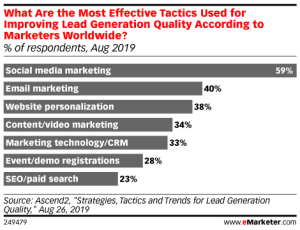
Every day, your customers are active on a huge range of channels, including social media. If you’re not present and engaging with them across all of these social media platforms… it’s killing your reputation, lead generation, and your bottom line.

How you define a quality “lead” depends on your industry, campaign, and goals. Generally speaking, a quality lead will include useful information and clear signs of intent to engage with your business.

Social media is now the preferred business contact platform. Use this to your advantage by actively engaging with (and converting) prospects and customers on all modern channels such as Twitter, Instagram, Facebook, LinkedIn, Pinterest, and Reddit. If you’re collecting social media leads, you need to be collecting analytics insights. Whether it’s product sales or new client and services type leads. How do you measure it coming from social media? Here are a few ways:

  • Google Analytics. Watch and review social media platform traffic (goals) in Google Analytics to track leads on your website. This will allow you to monitor which social media platform is the best source for your business. If you notice, for example, that Twitter outperforms Facebook, it may be worth redoubling efforts on that platform.
  • Social analytics tools. Tools such as Keyhole, Sprout Social, and Hootsuite also allow you to identify the type of creative and messaging (posts) that performs best. Most of these tools offer easy-to-review dashboards that offer metrics such as the number of impressions, reach, posts, and engagements that certain accounts or hashtags you are getting from each individual platform.
  • Engagement. Engagement is one of the most valuable metrics in measuring social media lead generation. You need to evaluate if you’re engaging with the right audience, how they are interacting with your brand, and what they are doing to engage with your topic and spread your content. The ideal engagement metrics include the number of likes, comments, shares, and re-tweets.
  • Tracking via a specific social media “discount code” or “social shopping”. Many brands offer customers a discount code in exchange for a product or newsletter sign-up. Discount codes or rewards points encourage customers to make a return visit to your site, and ideally a purchase. If you plan to offer one, have a strategy in place for not just generating leads, but also nurturing and converting them.
  • Social Media Ads metrics. The main metrics include Reach, Impressions, and Click-Through Rate.
  • Link Tracking on Social. Link tracking answers the question – “How did you find us? It involves tracking the number of clicks obtained by specific links on your social media posts. Link tracking is helpful in monitoring if your audience is clicking on links associated with your ads.

The above bullets can help you measure leads coming back through Social Media. In the meantime, what can actually help boost the % Leads using social media? 5 tips are below…

  • Optimize your profile. Your profile should provide the means for customers to contact you, sign up for your newsletter, shop, contact information, YouTube channel, etc. Your profile should always include a “link back” to your business website. Make sure to “Add a link” to your bio.
  • Create clickable content. Without compelling content, you won’t collect leads (clicks). Clickable content includes social media posts. Social Media posts include clickable content such as blog posts, YouTube channel content, and call to action type of content (landing pages) that can be SHARED.
  • Use social lead ads. Call to action ads can be posted on platforms such as Facebook, Instagram, YouTube, Linkedin, etc. Your best-performing Twitter posts can be “boosted” (just like paid ads) across that platform where you can dial in demographics such as gender, age, geography, etc.
  • Share testimonials as social proof. Customer stories and testimonials can give you the social proof you need to acquire new leads. Showcasing how clients have benefited from your products and services to demonstrate your brand value. Add these stories and testimonials to your website.
  • Leverage social media sponsorships. Instead of using paid ads, you could also attract leads from the social media content that your target audience is already consuming. Consider sponsoring shows, content, and YouTube channels that are popular with your target audience.


Content Creation Success is Measured Many Ways…

  • Spike in (unique) visitor traffic and page views on a specific content post.
  • The number of Shares, Likes, Pins, ReTweets on Social Media.
  • Media mentions and stories covering your business or firm.
  • Website ranking (SERPs) increase.
  • Time on page (Content). If you’re seeing higher time on page stats, they are […] engaging with your content.
  • Bounce rates. If the success of your site depends on users viewing more than one page (content), a high bounce rate is bad.
  • Conversions. Actual product sales or new clients (example: Financial Services).
  • Geography. Find out where your website visitors are coming from and how many. This helps content marketers optimize for the geographical locations (or geos) that are most important to their business.
  • How are the visitors reading your content? Mobile, Desktop, Tablet data can help (understand) trends and how to optimize your website design.

If you lack the resources for generating content, outsource to an agency or freelancer for help. The basic purpose is to create content and try to post at least 2-3 times per week. Content is scalable and you can add as needed or when more resources become available. Content Marketing is very important!

Content Creation Success Metrics

Besides driving traffic to your website, good content marketing reinforces your brand – your brand becomes a more famous name online as people notice your content and start remarking on it, retweeting it, helping to build you into a household name.

Content Strategy Answers the Question ‘Why’ You’re Publishing Content. Establishing content creation success metrics (KPIs) can determine how your marketing is performing as well as RIO. Below is a list of good basic success metrics for your content creation strategy:

  • Spike in visitor traffic and page views on a specific content post.
  • The number of Shares, Likes, Pins, ReTweets on Social Media.
  • Media mentions and stories covering your business or firm.
  • Website ranking (SERPs) increase.
  • Conversions. Actual product sales or new clients (example: Financial Services).

If you lack the resources for generating content, outsource to an agency or freelancer for help. The basic purpose is to create content and try to post at least 2-3 times per week. Content is scalable and you can add as needed or when more resources become available. Content Marketing is important! Without it, you’re going to struggle to attract the attention you need to collect leads and convert them into sales or clients!

How to Measure (ROI) Social Media Campaigns in 2022

Before starting any Social Media effort you must DEFINE your goals and targets (KPIs). A lot of these KPIs you can track from a CRM like HootSuite, HubSpot, Salesforce, or Sprout Social.

Basic Social Media Campaign KPI’s (Tangible) measurements:

  1. Product sales or qualified leads. New customers acquired. Not included: “converted leads” which are the responsibility of the sales organization or account manager.
  2. Increased revenue, and/or market share.
  3. Content Post CTR (Click-through rate) through Social Media platform.
  4. Site traffic (clicks back to website from a Social platform) or “sessions” by Social Media source

These are just a few basic metrics that you can use to measure your Social Media campaigns. So how do you measure the ever important “non-tangible” Social Media ROI?

  1. The quality of “buzz” or change in sentiment. Think Twitter buzz or the quality/quantity of blog feedback/comments. Develop an in-house engagement metric.
  2. Amount of relevant people handling digital content.
  3. Amount of “followers” or new members after a social media campaign. Not everyone’s social media goals is to sell product. Could be a branding goal or a service type goal.
  4. ReTweets
  5. Impressions
  6. Likes
  7. Connections

In the end, Social Media campaign goals must lead to increased revenue, SEO rankings (Google, and Bing are using “social signals” to help them rank), leads, branding/loyalty, or better service. It’s easy to present the tangible information to your boss or client. Make sure the non-tangible information is measured as well.